
Four acronyms, four vendors each claiming to cover the other three, and one operations team trying to figure out which system should actually be in charge. That is the real problem — not the definitions.
OMS, WMS, ERP, and TMS solve different problems, and the difference between them is not a feature list. It is a question of which system owns which decision.
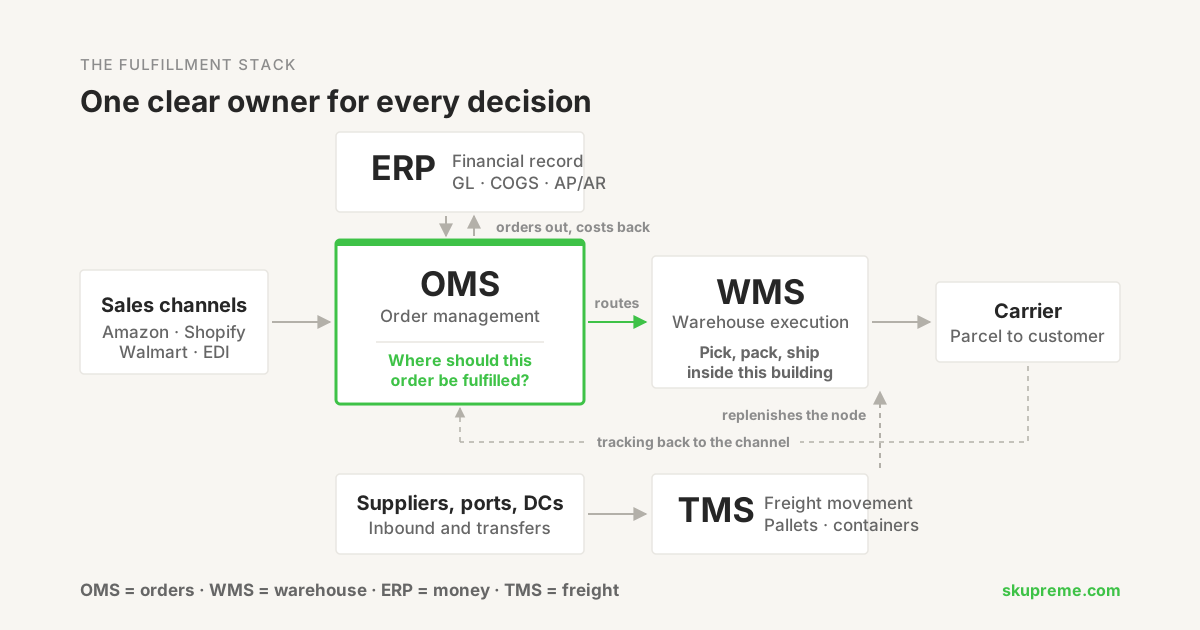
The short answer
Each system answers one core question:
- OMS (Order Management System): Where and how should this order be fulfilled?
- WMS (Warehouse Management System): How do we pick, pack, and ship it inside this building?
- ERP (Enterprise Resource Planning): How is this transaction recorded on the books?
- TMS (Transportation Management System): How should this freight physically move between locations?
| System | Primary purpose | Core question | Owns |
|---|---|---|---|
| OMS | Order and fulfillment orchestration | Where should this order be fulfilled? | Order lifecycle, routing rules, available-to-promise inventory, channel sync |
| WMS | Warehouse execution | How do we pick, pack, and ship it? | Bin-level inventory, labor tasks, receiving, putaway, packing |
| ERP | Financial and business management | How is this transaction recorded? | GL, AP/AR, inventory valuation, vendor and customer records |
| TMS | Freight and transportation management | How should this freight move? | Carrier selection, rating, tendering, routing, freight audit |
If you remember nothing else: OMS = orders, WMS = warehouse, ERP = money, TMS = freight.
The rest of this guide covers what each system actually does, where the four overlap, how to decide which one owns inventory truth, and which of them your operation needs at your stage.
What is an OMS?
An order management system (OMS) is software that manages an order from the moment it enters your operation through to delivery confirmation. It decides where each order gets fulfilled and keeps inventory, orders, and tracking synchronized across every sales channel.
For multichannel and omnichannel sellers, the OMS is the layer that sits between demand (marketplaces, carts, retail EDI, wholesale) and supply (warehouses, 3PLs, FBA, drop-ship vendors).
An OMS owns:
- Order ingestion from Amazon, Shopify, Walmart, TikTok Shop, eBay, and other channels
- A single, deduplicated view of every order across channels
- Available-to-promise inventory across all fulfillment locations
- Fulfillment routing — which node fulfills which order, based on inventory, shipping cost, and delivery SLA
- Order splitting when no single location can fill the whole order
- Backorders, pre-orders, holds, and partial shipments
- Rate shopping and label generation (or handoff to a carrier system)
- Tracking and status writeback to the originating channel
- Exception handling: stockouts, address failures, failed fulfillments, cancellations
OMS example
A customer orders two units on Shopify. The product is in stock in both Florida and California. The OMS evaluates on-hand inventory, the promised delivery date, and the landed shipping cost, routes the order to Florida, and sends the fulfillment request to that warehouse.
The OMS decided what should happen. What happens next inside the building belongs to the WMS.
What is a WMS?
A warehouse management system (WMS) runs the physical operation inside a single facility. Once an order has been assigned to a warehouse, the WMS directs the people and equipment that fulfill it.
A WMS owns:
- Receiving and putaway
- Bin, rack, and location management
- Bin-level, on-hand inventory accuracy
- Inventory movements and transfers within the building
- Cycle counting and physical inventory
- Pick paths, pick waves, and batch picking
- Barcode and RF scanning
- Packing stations, cartonization, and label printing
- Returns processing and disposition
- Labor management and warehouse productivity
WMS example
The OMS sends the order to Warehouse A. The WMS tells the picker: Aisle 4 → Rack B → Bin 17 → pick 2 units. The picker scans the item, brings it to a pack station, the box and label print, and the shipment closes out. The WMS reports the shipment and tracking number back to the OMS, which pushes it to Shopify.
One more acronym: where IMS fits
An inventory management system (IMS) tracks stock levels and valuation without running warehouse labor or routing orders. Many platforms marketed as an IMS are really a light OMS, a light WMS, or a reporting layer. Judge these by which decisions they own, not by the label.
What is an ERP?
An enterprise resource planning (ERP) system manages the financial and administrative record of the business. NetSuite, SAP, Microsoft Dynamics, and Acumatica are built around the general ledger and the company’s books.
An ERP owns:
- Accounting, general ledger, and financial close
- Accounts payable and accounts receivable
- Purchase orders, vendor records, and procurement
- Customer and pricing master data
- Inventory valuation and cost of goods sold
- Multi-entity, multi-currency, and subsidiary structures
- Financial and management reporting
- Tax and compliance
ERP example
A $250 order ships. The OMS ran the fulfillment decision and the WMS moved the units. The ERP records the revenue, the COGS, the inventory reduction, the customer receivable, the shipping expense, the tax liability, and the payment reconciliation.
That is why the ERP and the OMS have to talk — and why one cannot replace the other.
What is a TMS?
A transportation management system (TMS) manages the movement of freight between locations. The OMS decides that inventory needs to be somewhere; the TMS determines how it gets there.
A TMS owns:
- Truckload (FTL) and less-than-truckload (LTL) shipping
- Freight rating and rate comparison across carriers
- Carrier selection and shipment tendering
- Load building, consolidation, and route planning
- Appointment scheduling and dock coordination
- Freight tracking and in-transit visibility
- Bills of lading and freight documentation
- Freight audit, payment, and cost allocation
A TMS earns its keep when you regularly move freight between suppliers and warehouses, ports and distribution centers, DCs and retail stores, or your own facilities and 3PLs.
TMS example
Eighteen pallets need to move from a New Jersey DC to a Florida warehouse to rebalance inventory ahead of Q4. The OMS or planning layer identifies the need. The TMS rates the lane, selects the carrier, tenders the load, books the pickup, and tracks the freight to delivery.
Note the difference from parcel: parcel rate shopping for individual customer orders usually lives in the OMS or a shipping platform. Freight is TMS territory.
Who owns inventory? The question that breaks most stacks
“Single source of truth” is the most repeated and least useful phrase in operations software. In a real multi-node stack, four systems legitimately hold four different inventory numbers — and they should not match.
| Data | Owned by | Why |
|---|---|---|
| Bin-level on-hand quantity | WMS | It is the only system watching the physical shelf |
| Available-to-promise across all nodes | OMS | Only it sees every channel’s demand and every node’s supply |
| Inventory valuation and COGS | ERP | Costing rules and the books live there |
| In-transit and inbound freight | TMS (or OMS) | It controls the shipment record |
| Channel-facing sellable quantity | OMS | It applies buffers and allocation per channel |
| Purchase orders and vendor commitments | ERP or OMS/purchasing layer | Whichever system issues the PO |
| Order status and fulfillment state | OMS | It is the only system that sees the whole order |
| Pick, pack, and labor tasks | WMS | Execution happens in the building |
The rule that keeps a stack sane: the system that observes an event should be the system that publishes it. The WMS observed the pick, so the WMS reports it. The carrier scan reaches the OMS, so the OMS reports the shipment to the channel. When two systems both write the same fact, you get drift — and drift shows up as oversells.
OMS vs. WMS
This is the most commonly confused pair, and the distinction is simple:
- An OMS manages orders across the network. It is horizontal — it spans every channel and every node.
- A WMS manages work inside one facility. It is vertical — deep in one building.
One OMS can coordinate five warehouses, each running a different WMS. A WMS has no opinion about which of your five warehouses should have received the order in the first place.
If you use a 3PL, the WMS is usually your partner’s software, not yours. You should not buy a WMS to manage a warehouse you do not operate. You still need the OMS, because routing across your 3PLs, FBA, and your own stock is your decision, not theirs.
OMS vs. ERP
An ERP is built around business administration and financial records. An OMS is built around real-time execution.
That difference is architectural, not cosmetic. ERPs are designed for correctness at period close: batch processes, approval flows, and audit trails. Order routing is the opposite problem — thousands of small decisions a day that need to happen in seconds against constantly changing inventory.
You can push an ERP into order management, and plenty of teams do. It starts to strain when you add marketplaces, more fulfillment nodes, 3PLs, conditional routing rules, and carrier logic. The usual symptoms are customizations no one wants to touch, overnight syncs that make inventory stale by morning, and a channel team that keeps a spreadsheet because the ERP cannot answer “can we promise this by Thursday?”
For most companies over a certain complexity, this is not either/or. The ERP keeps the books and the OMS runs the execution, with a clean integration between them — orders and shipments flowing to the ERP, purchase orders, costs, and vendor data flowing back.
WMS vs. ERP
Most ERPs include warehouse modules. They work when a warehouse is simple: a handful of locations, low volume, no wave picking, minimal scanning.
You want a dedicated WMS when the building itself is the constraint — when directed putaway, pick path optimization, wave planning, labor standards, and real-time scanning start to determine your throughput. ERP warehouse modules are typically transaction-oriented; a WMS is task-oriented and built for people moving on a floor.
OMS vs. TMS
The OMS decides what needs to move and where it needs to go. The TMS decides how it moves. The clean split in practice: parcel shipments to end customers are usually an OMS or shipping-platform function, while pallet and container freight between your own facilities and partners belongs to the TMS.
How the four systems fit together
For a typical direct-to-consumer order:
Sales channel → OMS → WMS → carrier → tracking back to the channel
Running alongside it:
OMS ↔ ERP (orders, shipments, and costs in; POs, pricing, and vendor data back)
And for inventory movements rather than customer orders:
Supplier or DC → TMS → warehouse, DC, or 3PL
Each system controls a different layer. The integrations between them are where operations either scale or quietly fall apart.
Do you need all four systems?
No. The right architecture depends on complexity, not on revenue alone. Here is how the stack tends to evolve.
One channel, one fulfillment location
Shopify → 3PL
Your ecommerce platform and your 3PL’s portal are enough. Do not buy an OMS to manage a single channel and a single node.
Multiple channels, one or two nodes
Amazon + Shopify + Walmart → OMS → 3PL or in-house warehouse
This is the point where an OMS starts to pay for itself. Two channels selling from the same pool of inventory is an allocation problem, and spreadsheets solve it right up until the first oversell during a promotion.
Multiple channels, multiple nodes
Sales channels + retail EDI → OMS → multiple 3PLs / WMS systems → carriers
Routing is now a real cost lever: which node ships which order changes your shipping spend and your delivery promise on every single order. An OMS is no longer a convenience, it is the control layer.
Enterprise, multi-entity, freight-heavy
Sales channels → OMS → multiple WMS and 3PL systems, integrated with ERP + TMS + carriers + suppliers
At this scale, all four exist, and the OMS is the orchestration layer holding the commerce side of the stack together.
Signals you have outgrown your current setup
You probably need an OMS when:
- You sell the same SKU on three or more channels
- You fulfill from two or more locations, including FBA or a 3PL
- Someone manually decides which warehouse ships which order
- Oversells or stockouts happen during promotions
- A spreadsheet reconciles inventory between systems
- Channel-facing inventory is updated on a schedule instead of on events
You probably need a WMS when:
- You operate your own warehouse and pickers walk more than they pick
- Inventory accuracy is below the point where you trust your own numbers
- You need directed putaway, wave picking, or labor reporting
You probably need an ERP when:
- Multiple legal entities, currencies, or subsidiaries are in play
- Your accounting software can no longer support inventory costing and close
- Auditors, lenders, or investors need financial controls your current tools cannot produce
You probably need a TMS when:
- You move pallets or containers weekly, not occasionally
- Freight is a meaningful line item and nobody can explain the variance
- Someone is emailing carriers for quotes
Why these categories overlap
Every platform expands beyond its original category. A WMS adds order management. An ERP adds warehouse functionality. An OMS adds purchasing or freight. A TMS adds inventory visibility.
Overlap is not the same as interchangeability. The useful question during evaluation is not “can it do X?” — most demos can. It is:
Which system owns each decision, and which one publishes each fact?
Then hold that line:
- The ERP owns the financial record.
- The OMS owns fulfillment routing and available-to-promise.
- The WMS owns warehouse execution and bin-level accuracy.
- The TMS owns freight movement and cost.
Define authority before you define connectivity. Most failed implementations are not integration failures — they are unresolved arguments about ownership that surface six months in as conflicting inventory numbers, duplicate orders, and statuses that mean different things in different systems.
Four failure patterns to test for in a vendor demo
- Dual writes. Two systems both update sellable inventory. Ask which one wins and how you would know.
- Status drift. “Shipped” means label printed in one system and scanned by the carrier in another. Ask for the exact trigger.
- Silent partial failure. An order syncs but its line-level allocation does not. Ask what surfaces the mismatch and where.
- No reconciliation. Real-time sync without a daily true-up hides errors instead of catching them. Ask what the reconciliation report looks like.
Where Skupreme fits
Skupreme operates at the order management and operations layer — the OMS in this stack.
It connects sales channels, inventory, catalog, purchasing, warehouses, 3PLs, and shipping into one operational layer. Orders from 25+ channels — Amazon, Shopify, Walmart, TikTok Shop, eBay, and retail EDI programs — are unified, then routed on inventory availability, shipping cost, and delivery SLA rather than by hand.
That includes the pieces that usually get bolted on separately: smart routing across nodes, carton optimization, carrier rate shopping, kitting and bundling, and purchase order management.
Skupreme does not replace your ERP or your 3PL’s WMS. It integrates with them — NetSuite, Sellercloud, ShipHero, Extensiv, Logiwa, SkuVault, FBA and AWD, and parcel and freight carriers — and owns the layer between them, so routing rules live in one place instead of in five portals and a spreadsheet.
If your team is currently stitching together a channel manager, a shipping tool, an inventory spreadsheet, and three 3PL logins, that is the gap it fills. See how Skupreme compares to the point solutions it usually replaces.
Frequently asked questions
What is the difference between an OMS and a WMS?
An OMS manages orders across your entire network and decides where each order should be fulfilled. A WMS manages the physical work inside one warehouse — receiving, putaway, picking, packing, and shipping. One OMS can direct orders to several warehouses, each running its own WMS.
Can an ERP replace an OMS?
For simple operations, yes. As you add sales channels, fulfillment locations, 3PLs, and routing rules, ERPs tend to struggle because they are built for financial accuracy at period close rather than real-time order execution. Most companies past that point run both and integrate them.
Do I need a WMS if I use a 3PL?
No. Your 3PL operates the building and provides the WMS. What you need is an OMS, because deciding which 3PL, marketplace, or warehouse fulfills each order is your decision to make.
What is the difference between a WMS and a TMS?
A WMS manages inventory and labor inside a facility. A TMS manages freight moving between facilities. The WMS stops at the dock door; the TMS starts there.
Which system should be the source of truth for inventory?
It depends on the question. The WMS is authoritative for physical on-hand quantity by location, the OMS for what is available to promise across the network, and the ERP for valuation and COGS. Those three numbers legitimately differ, and forcing them to match is a common architecture mistake.
Do I need an OMS if I only sell on Shopify?
Usually not, if you also fulfill from a single location. An OMS becomes valuable when the same inventory is sold across multiple channels or shipped from multiple nodes.
Is an OMS the same as an inventory management system?
No. An IMS tracks stock levels. An OMS tracks stock levels and orchestrates order routing, allocation, fulfillment, and channel synchronization. Many tools marketed as inventory systems are really one of the two.
What order should you buy these systems in?
Follow the constraint. Multichannel and multi-node complexity points to an OMS. Warehouse throughput points to a WMS. Financial and multi-entity complexity points to an ERP. Freight spend points to a TMS. Buying in the wrong order is how teams end up with an expensive system nobody uses.
The bottom line
OMS, WMS, ERP, and TMS each manage a different layer of the supply chain:
- OMS = orders and fulfillment orchestration
- WMS = warehouse execution
- ERP = financial and business records
- TMS = freight and transportation
In a simple operation, one platform can cover several of these jobs. As complexity grows, separating the responsibilities matters more than consolidating the vendors.
The goal is not fewer systems. It is one clear owner for every operational decision, and information that moves between systems reliably. For growing omnichannel businesses, the OMS is increasingly the layer that makes that possible.
Running multiple channels, warehouses, and 3PLs? Request a call and see what your stack looks like with one orchestration layer instead of five point solutions.
